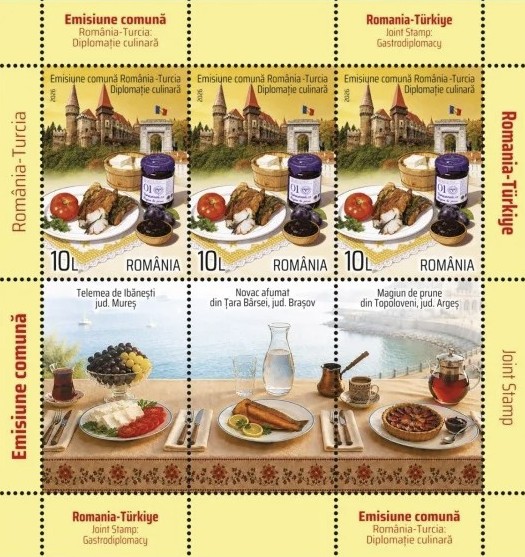
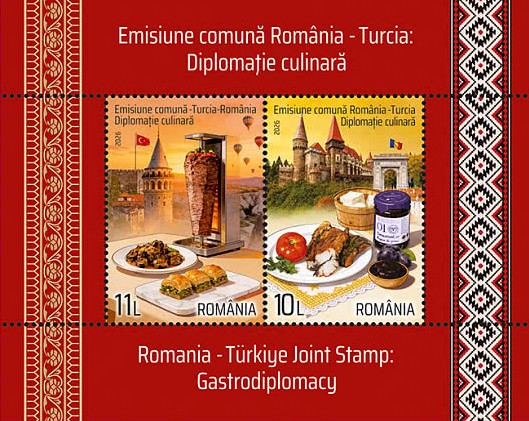
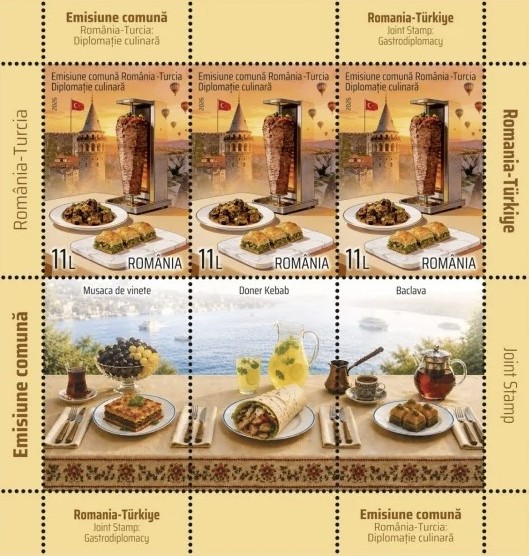
On June 30, 2026, Romania and Türkiye celebrated relationship with joint stamps depicting local gastronomy. Both countries issued two stamps with the same design. The postage stamp with the theme of Romania reproduces three representative products with European recognition: Topoloveni Plum Jam, Ibănești Telemea and Smoked Bighead Carp from the Land of Bârsa. On the stamp background are illustrated Corvin Castle located in the southwestern part of Transylvania, in the centre of Hunedoara County, and a miniature image of the Arch of Triumph in Bucharest, bearing the Romania’s flag. The postage stamp to the Republic of Türkiye, depicts the world-renowned Döner kebab, alongside a serving of eggplant moussaka and the traditional dessert known as baklava, set against an iconic view of Istanbul featuring the Galata Tower with a Turkish flag.
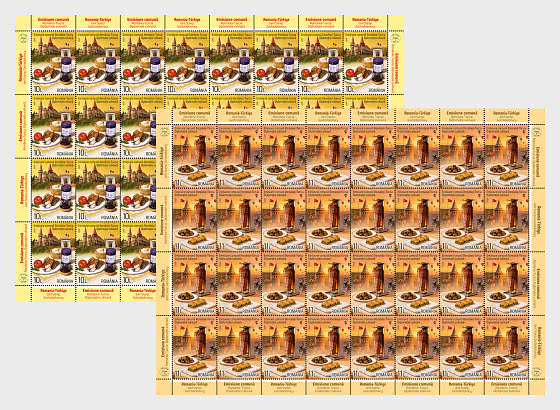
Turkiye issued the pair of stamps as se-tenant included in a souvenir sheet produced at 100,000 samples. As usual, Romanian production is more complicated with both stamps produced in panes of 32 units (2x[8×4]) (2×8,768 stamps corresponding to 2×274 panes), but also in two miniature sheets containing three stamps each above three different labels (2×2,925 miniature sheets issued), as well as a souvenir sheet with both stamps se-tenant (4,500 souvenir sheets).





Big surprise with the Indonesia Uruguay joint issue scheduled initially for release on March 30, 2026 and remaining without news since: both designs appeared now on the web. Both countries issued a miniature sheet with 8 different stamps, showing as announced, handicrafts with jewelry. The stamps were issued on July 20, 2026, and for Indonesia apparently only at 3,000 samples.
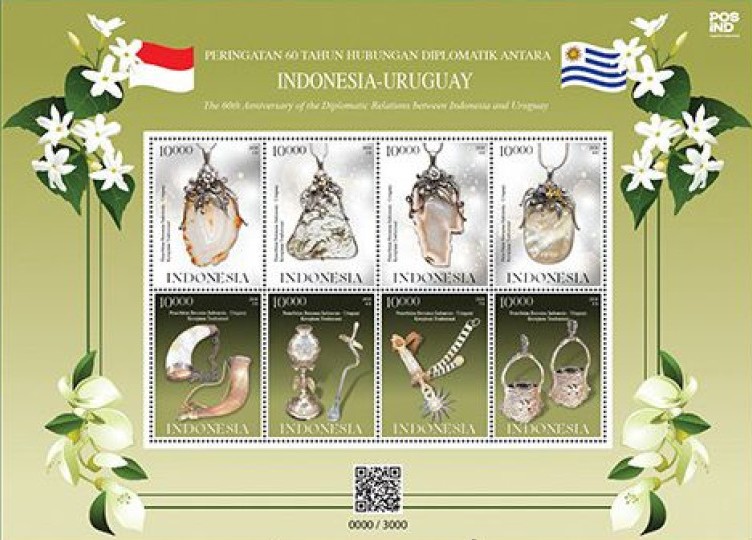
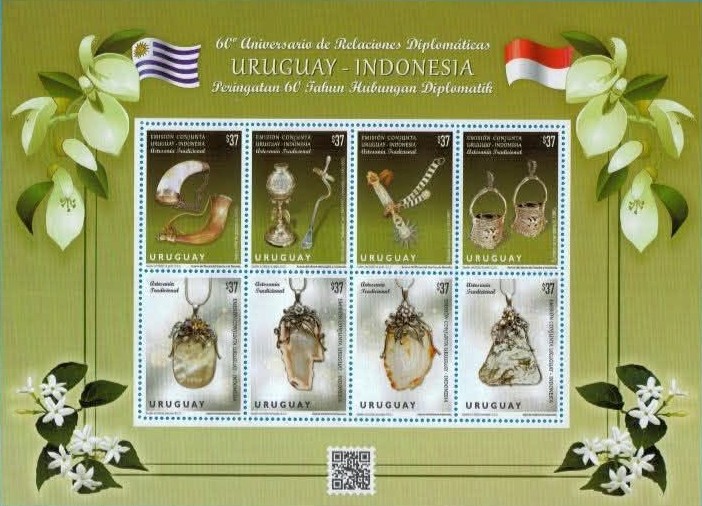
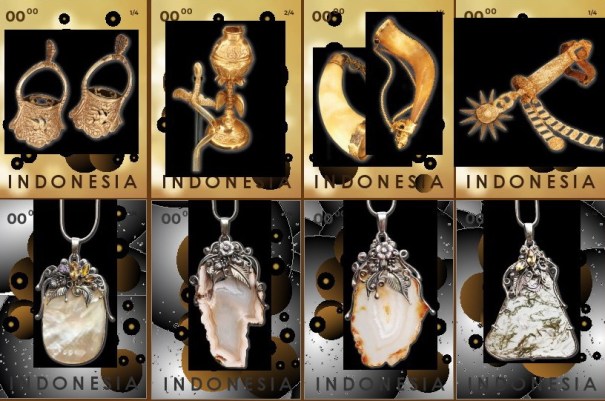
The stamps do show the items displayed based on the original proposal, but the overall design has been greatly modified. Below is a reminder of the image we had in hands since beginning of the year.
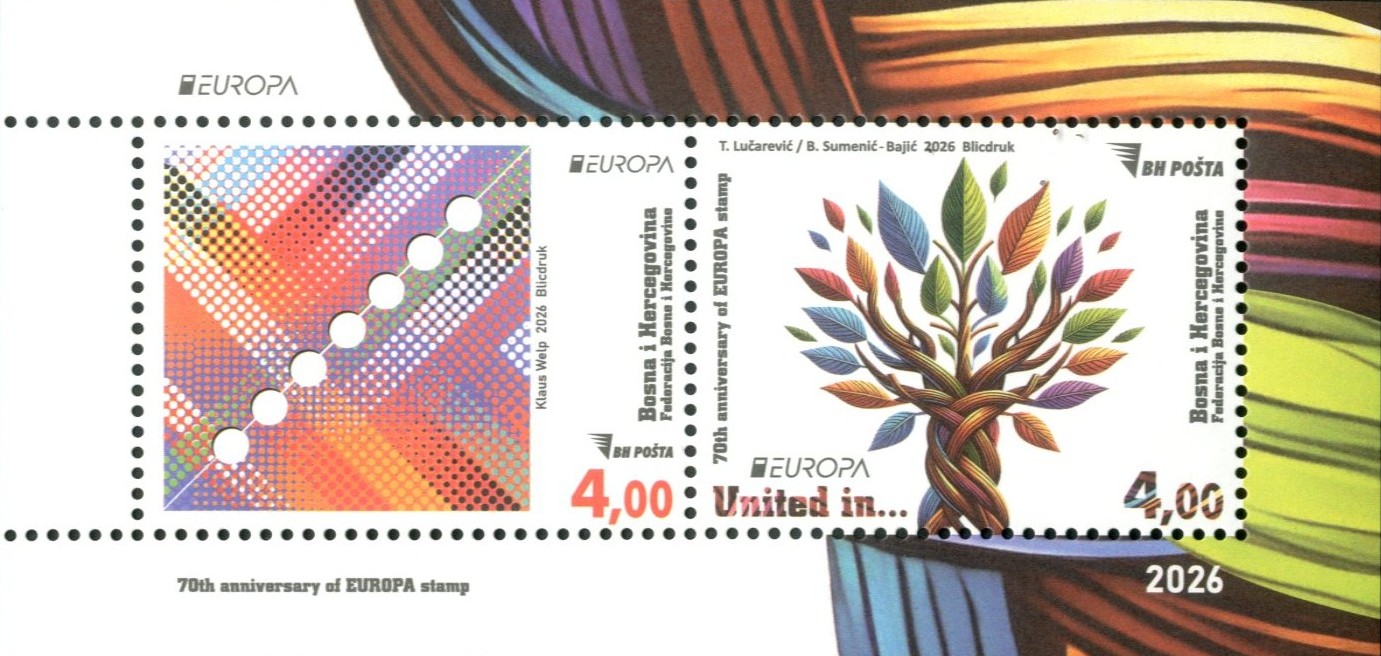
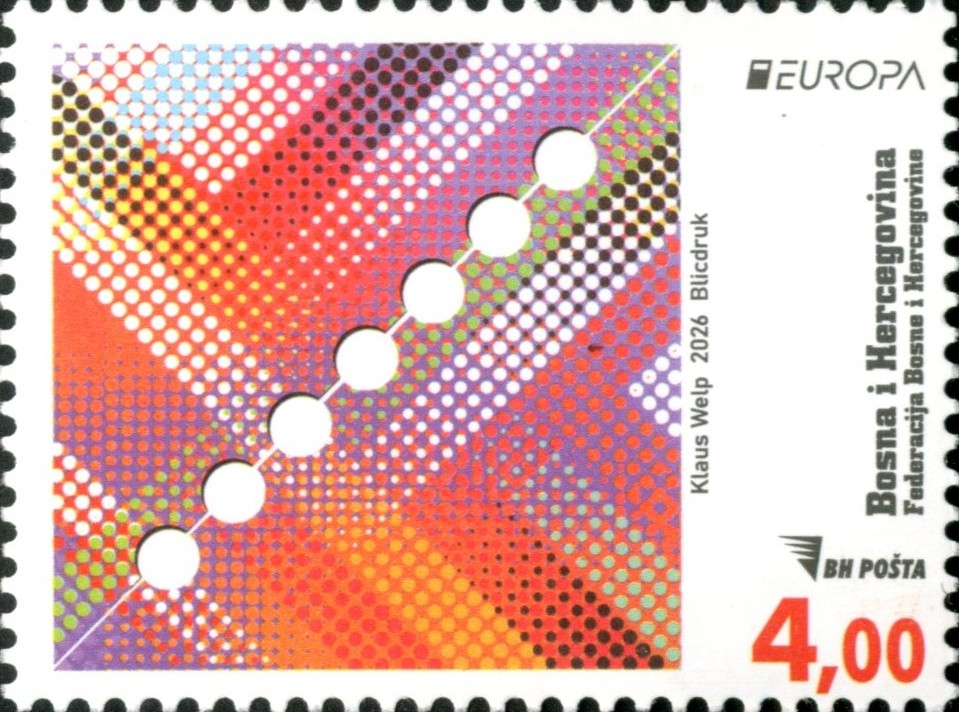
Regarding the 2026 Europa series [T20260508], Bosnia Herzegovina issued stamps on June 25, 2026 (and not on May 8 as initially scheduled). Bosnia Herzegovina issued two stamps, one with the common design, in panes of 10 stamps (2x[2×5]) and in a souvenir sheet containing both se-tenant stamps.
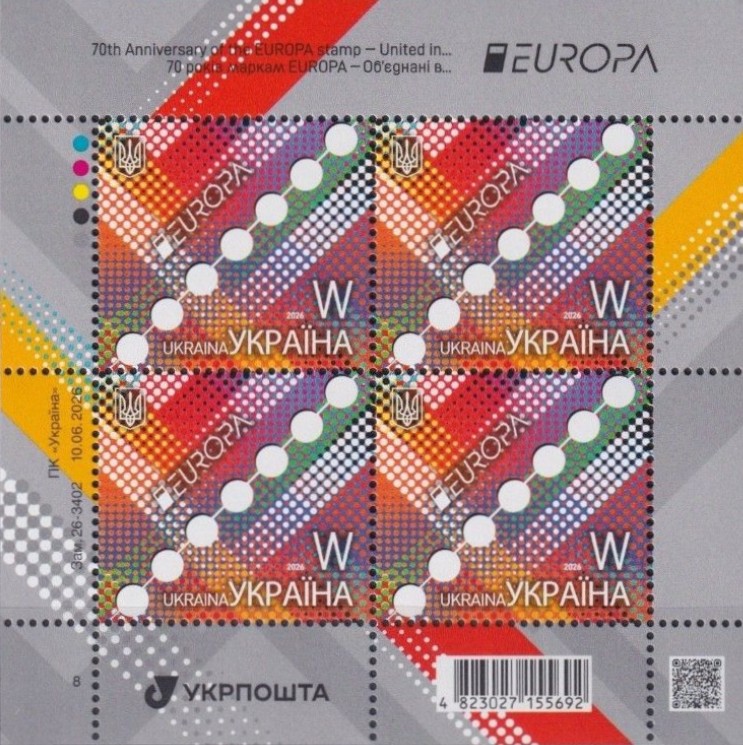
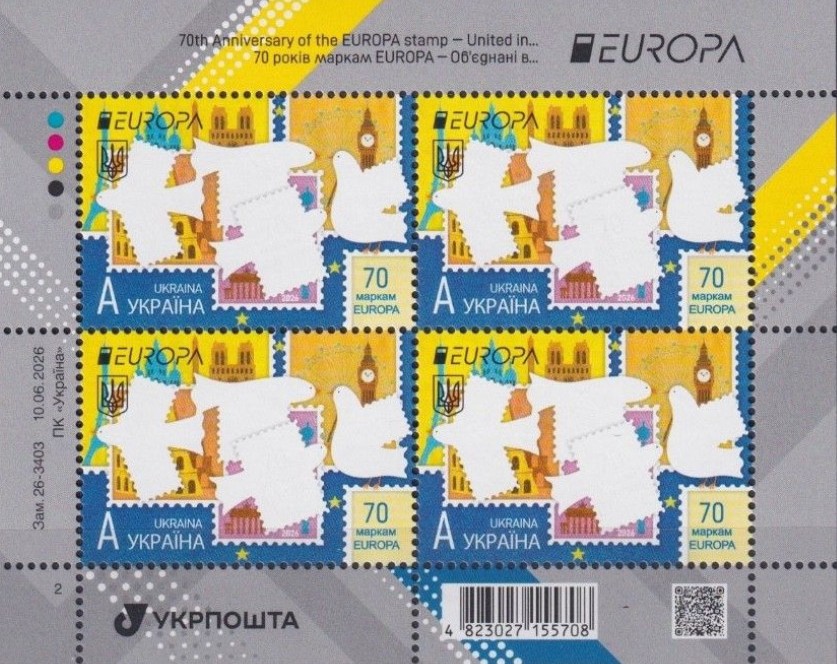
On July 10, 2026, Ukraine‘s Europa stamps were also released in forms of two different designs, available in miniature sheets of 4 stamps (2x[2×2]), a booklet with a souvenir sheet containing both stamps (issued at 1,700 samples) and a similar souvenir sheet with both stamps, issued at 4,400 samples (and available only for yearly Ukrainian stamp subscribers).





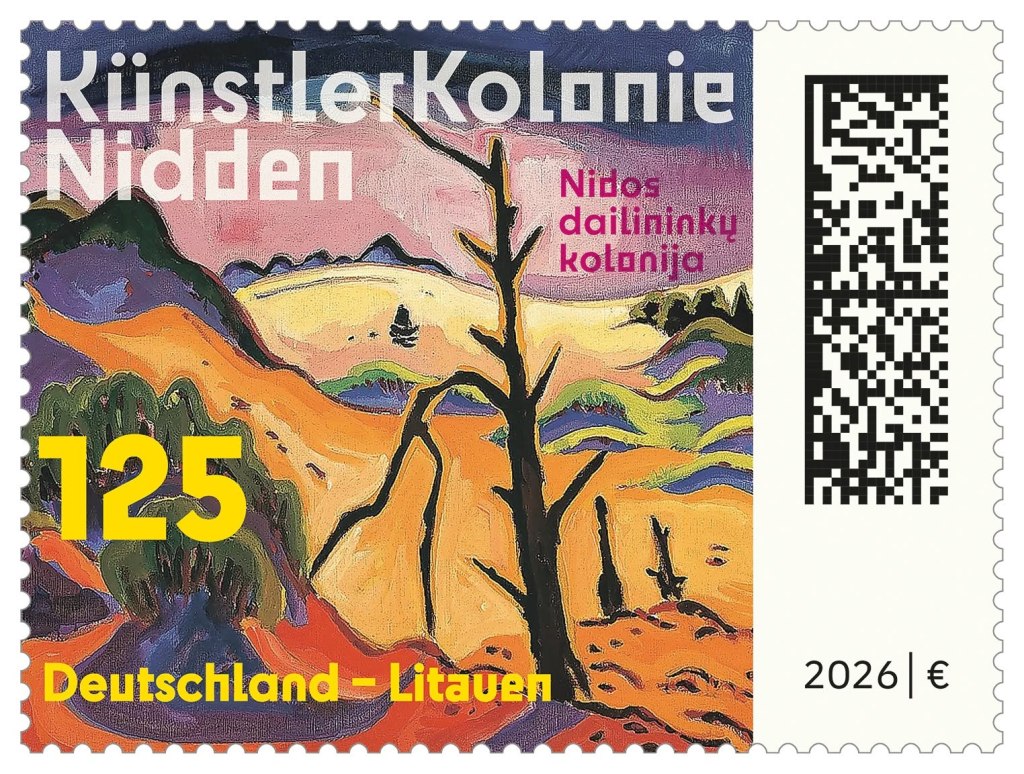
On August 6, 2026, Germany and Lithuania will celebrate with a joint issue, the existence of the Nida Colony, a Lithuanian coastal village that hosted numerous of artists since the end of the 19th century (at that time part of Prussia). The designs of the stamps became already available and show a painting from Karl Schmidt-Rottluff (1884-1976).

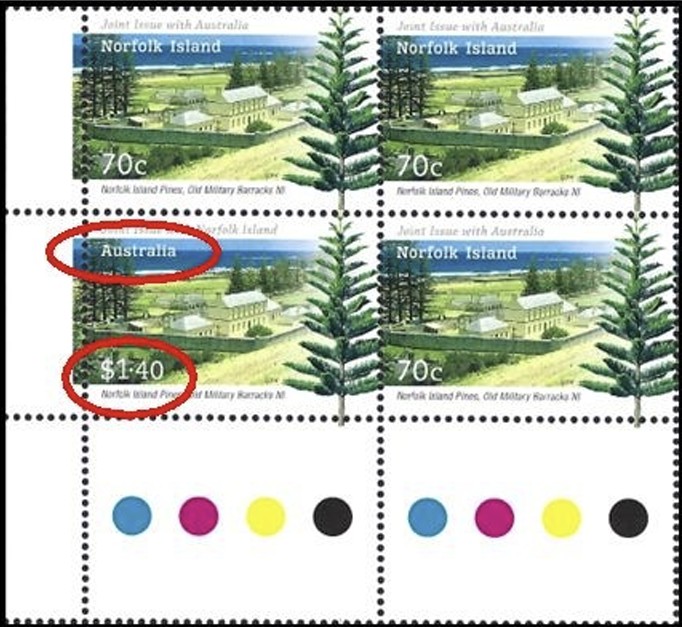
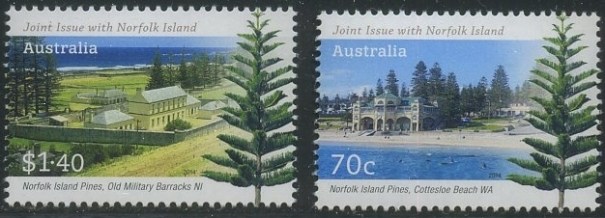
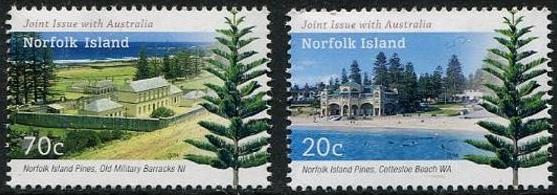
In the most recent issue of the the journal Pacifica (July 2026, Vol 64 N° 256), from the Pacific Islands Study Circle (PISC), B. Allen Shaw, a specialist of Norfolk, describes over two pages (p43-44) a surprising constant error in the panes of the Norfolk stamps from the July 22, 2014 joint issue with Australia [catalogue Vol 12, D20240722]. On that date, the Norfolk Island Philatelic Bureau, and Australia Post, produced four stamps of two designs featuring the emblematic Norfolk Island Pine. Endemic to Norfolk Island. The two designs featured were: a view of the Norfolk Island Pines on Cottesloe Beach, in Western Australia; and a view of the Norfolk Island Pines surrounding the Old Military Barracks, on Norfolk Island. The values of the Norfolk Island stamps were: 20c for the Cottesloe Beach design; and 70c for the Old Military Barracks design. The Australian counterparts were 70c and $1.40 respectively. The stamps were printed by RA Printing Pty Ltd, Melbourne, Australia, on Tullis Russell gummed paper in sheets of 50; two panes of 25 separated by a gutter, and the gutter having the printers colour dots only. The quantity of Norfolk Island stamps printed was 12,000 for each
value. This equates to 240 sheets of 50 stamps each.
An error occuring on each sheet of Norfolk Island 70c stamps was discovered: stamp #21, located in row 5 and position 1, was actually the Australian counterpart of this joint issue. The stamp is inscribed “Australia”, with the value of “$1.40”, in error. The remaining forty-nine stamps are correctly inscribed “Norfolk Island”, with the value of “70c”. The items (full panes) were discovered in the archives of the Norfolk philatelic offices. With the very low number of printed sheets (240) and the late discovery, it is possible that this archive sheet will remain unique. So, do not lose time to try finding another sample, but if so, do not hesitate to tell us.
Mario Moni (Italy) enquired about an explanation regarding the absence of description of some colonial Italian issues in the catalogue, while others, such as the 700th anniversary of the death of Saint Anthony of Padua [D19310507], the Graf Zeppelin’s airship journey [D19330505] or the Naples Colonial Exhibition [D19341016] are present. Mario’s additional list includes the following: Dante Alighieri Society, March 14, 1932 with additional value issued on August 6, 1932; Giuseppe Garibaldi, April 6, 1932; 10 years of Rome March, October 27, 1932; Balboa Cruise, May 20, 1933; Football championship, May 24, 1934; 100 years of the Courage Gold Medal, September 6, 1934 and 2000 years of August Emperor on September 23, 1937.
By re-checking the Italian colonies that have used the similar topics and stamps as basis (including Aegean Islands, Cyrenaica, Eritrea, Italian East Africa, Italian Ethiopia, Italian Libya, Italian Somalia and Tripolitania), it appears that none of the rare stamps issued at the same occasions as listed above can be considered as joint. Stamps issued at different dates with different designs (e.g. Balboa Cruise) are excluded on the basis of the definition of joint issues. Also, overprints of existing stamps from another country are not to be considered as joint as well. In particular, this is the case for the Aegean Islands stamps which are all overprinted Italian stamps. As a conclusion, the list of Italian territorial series [D] from the period 1927-1937 described in the catalogue seems to be complete already.
Catalogue pages were updated accordingly.

